ACC-1010 runs as a mentor-guided module sequence on TESU's 12-week clock, and this page is its help desk: the honest read on what the course grades and the exact support behind it.
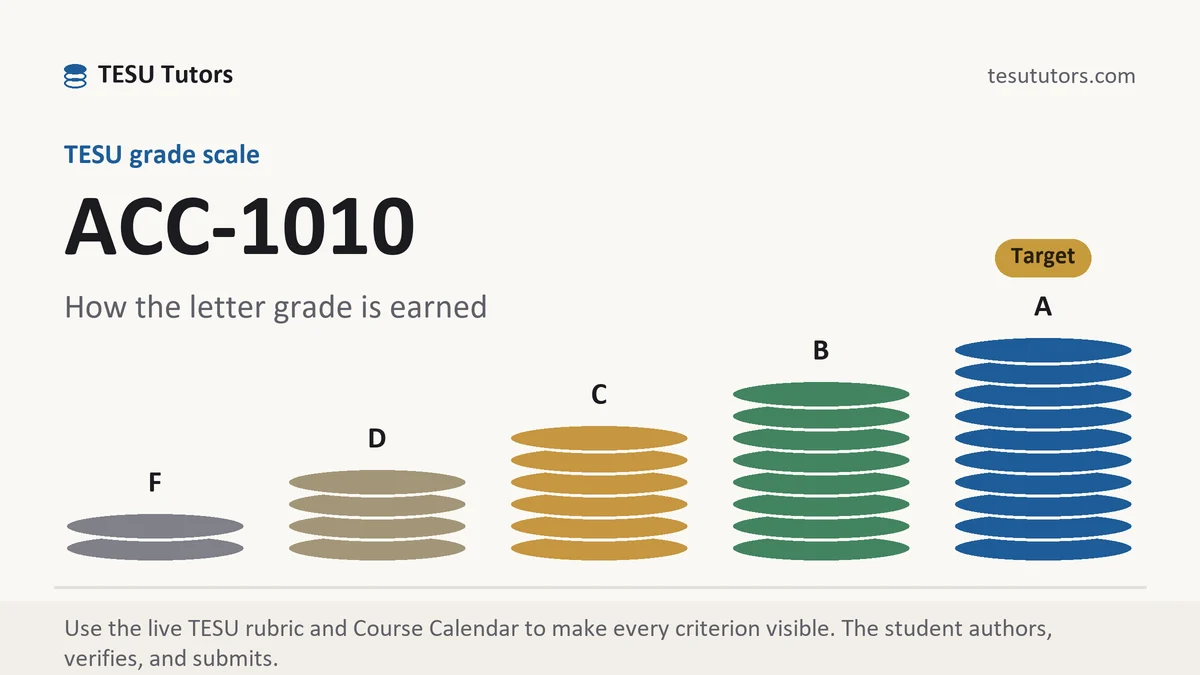
What ACC-1010 actually grades
The debits-and-credits gateway: transactions journaled, statements assembled, and the vocabulary of accounts installed precisely, graded through problem sets and written analyses where arithmetic and explanation must agree.
How we help in this course
Worked solutions with every step visible and short-answer writing that explains the numbers it presents, because mentors here grade the reconciliation between your figures and your prose. The walkthrough rebuilds the rusty arithmetic layer for adults a decade past their last math class.
Service terms are the site standard: drafts to the rubric in 24 to 48 hours, boards same-day when needed, proctored checks split through prep-only exam support, free revision until the letter posts, and the three 2.0 floors treated as the cliffs they are. If this requirement might clear cheaper as a test-out, the TECEP consult says so honestly, free, before you spend course money.
Module manuals for this course
Module-level manuals for ACC-1010 publish as each deliverable identity verifies against the current term build; chat knows live coverage same-day, and the service never waits on a manual.
In ACC-1010 right now?
Send the module's instructions and rubric from myEdison. First premium sample free, back in 24 to 48 hours.
Reconciliation is the graded skill
Accounting modules here grade the agreement between your figures and your prose: transactions journaled so they balance, statements assembled correctly, and short-answer writing that explains the numbers it presents. A mentor reading both halves will find a mismatch faster than any spreadsheet, so our worked solutions ship with every step visible and the explanation reconciled to the arithmetic line by line. On a ladder with no A+ above it, an A in a problem-set course is the ceiling itself, and clean reconciliation is how that ceiling gets banked early.
Twelve weeks, one Calendar, monthly cohorts behind you
The Course Calendar spreads this course's modules across the twelve-week term, and the monthly-start system means another cohort is always forming behind yours, which makes drift feel cheap right up until week nine compresses. The desk's role is mechanical: module instructions and rubric in from myEdison as each opens, worked drafts back inside 24 to 48 hours through both QA passes, the walkthrough rebuilding the arithmetic layer for anyone a decade past their last math class.
Run the fork before tuition spends
Accounting requirements deserve a credit-bank look before course money moves: the chat desk checks free whether a test-out or portfolio route could clear yours at exam-fee prices instead of per-credit ones, and answers honestly either way. If the course wins the fork, the free first sample covers a full module deliverable, both QA passes included, revision free until the letter posts, so the audit costs nothing whichever lane you take.