Professional MBA in Healthcare Management program and course guide
Start with the official program, open the exact course, then work through its syllabus-verified or openly disclosed Module rail beside myEdison and Moodle.
Professional MBA in Healthcare Management is present in TESU's current catalog. This map preserves its published requirement headings and exact course rows without turning alternatives into requirements or transfer-friendly space into promised credit.
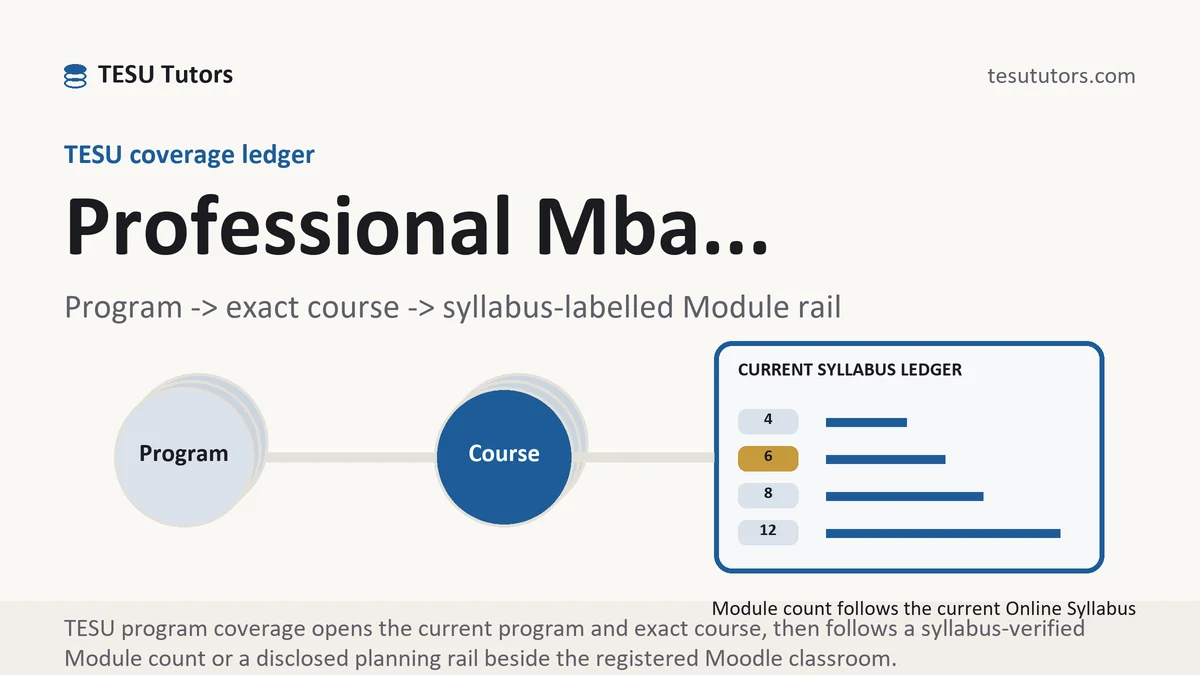
How to read this program map
Read this health curriculum as a movement from science and systems literacy toward quality, policy, administration, access, finance, population evidence, and accountable professional decisions. Licensed experience and approved credential credit are not online assignments and are never simulated here.
The published headings are requirement groups, not a promised personal order. Mark every row required, alternative, concentration, elective, transfer-complete, planned, active, or complete using the student's current MyProgress evaluation, degree audit, transfer decision, and advisor guidance.
A course can appear in several programs, concentrations, or option groups without requiring repeated enrollment. Each exact code therefore resolves to one canonical course guide that carries every current program backlink, the catalog description, and its own Module evidence status.
Current published curriculum
The tables below follow the current TESU SmartCatalog page. Credits are preserved when the row exposes them; flexible, transfer, credential, and elective space is never filled with invented course requirements. The student's governing catalog and MyProgress evaluation decide the personal plan.
I. Core Courses (15 Credits)
| Course | Catalog title | Credits | Native work |
|---|---|---|---|
| ETM-7500 | Ethics for Managers | 3 | Module 1-5 syllabus-verified |
| MKM-7000 | Marketing Management | 3 | Module 1-4 syllabus-verified |
| FIN-7100 | Financial Management | 3 | Module 1-5 syllabus-verified |
| SOP-7200 | Strategic Operations Management | 3 | Module 1-4 syllabus-verified |
| GSM-7300 | Global Strategic Management | 3 | Module 1-6 syllabus-verified |
II. Area of Study (12 Credits)
| Course | Catalog title | Credits | Native work |
|---|---|---|---|
| HCD-7030 | Healthcare Delivery | 3 | Module 1-4 syllabus-verified |
| HCF-7010 | Healthcare Finance | 3 | Module 1-4 syllabus-verified |
| HCL-7040 | Healthcare Law | 3 | Module 1-8 syllabus-verified |
| HCO-7020 | Strategic Management within a Healthcare Organization | 3 | Module 1-4 syllabus-verified |
Select one from the following:
| Course | Catalog title | Credits | Native work |
|---|---|---|---|
| ENP-7320 | Entrepreneurship | 3 | Module 1-4 syllabus-verified |
| HRM-7600 | Human Resource Management - Talent Management | 3 | Module 1-8 syllabus-verified |
| PJM-7210 | Project Management | 3 | Module 1-4 syllabus-verified |
| SOM-7020 | Social Media Marketing | 3 | Module 1-4 syllabus-verified |
| NEG-7310 | Negotiations | 3 | Module 1-8 syllabus-verified |
| MCO-7400 | Management Communications | 3 | Module 1-8 syllabus-verified |
Build the personal sequence
Export the current MyProgress evaluation and create one row for requirement group, course code, title, credits, prerequisite, transfer or credential decision, planned term, delivery method, registration state, and completion evidence. Keep alternative rows in a decision column. Ask TESU to confirm any substitution, overlap, residency, age-of-credit, or transfer assumption before using it to remove a requirement.
Add every non-course dependency beside the curriculum: admission condition, professional license or certification, laboratory or clinical clearance, placement, practice setting, preceptor, simulation, research approval, live session, group meeting, technology requirement, graduation audit, and state authorization that applies. A student can be current in every Moodle course while an external gate still controls progression.
From course to the live Module
TESU's public syllabi show why term duration must not become module count: the mapped courses range across different Module structures. A course page uses its current public Online Syllabus when available and says so. If TESU publishes no current syllabus link, the course page exposes a six-position planning rail and instructs the student to replace every position with the registered Moodle organization.
At the opening of each live Module, capture its title, objectives, readings, media, discussion, reply requirement, written assignment, calculation, laboratory or simulation, quiz or examination, project milestone, rubric, point value, due date, permitted resources, and submission route. The Course Calendar and mentor directions control conflicts.
Keep evidence and mentor feedback cumulative
Maintain one evidence ledger across the program: course, live activity, rubric criterion, question or decision, source, authority or study design, date, finding, limitation, and intended use. Maintain a feedback log beside it with criterion, mentor comment, diagnosis, correction, and a rule to carry forward. Methods should improve across courses without recycling submitted language.
Quantitative work needs a parallel calculation record containing source values, units, formula, transformation, output, reasonableness check, and interpretation. Professional examples must be lawful, authorized, and de-identified. Patient, client, employer, peer, and research-participant details never become raw material for a public tutor.
Delivery and student-performed boundaries
Online or credentialed delivery does not authorize outsourced authorship, exams, discussions, group participation, labs, professional activity, research, presentations, practice, identity checks, or submission. The student performs, verifies, authors, personalizes, and submits.
A tutor may explain concepts, model a method on parallel material, create practice, help plan research, ask diagnostic questions, and critique student-authored work. A tutor does not request school credentials, enter Moodle, impersonate the student, take a quiz or TECEP, post discussions, fabricate sources or data, perform clinical or professional activity, log hours, sign forms, contact TESU as the student, or submit work.
Program-level quality gate
Before registration, reconcile the governing catalog, MyProgress, transfer evaluation, prerequisites, residency, delivery method, term, and non-course dependencies. Before each submission, reconcile the exact instructions, rubric, assigned resources, evidence, calculations, citations, format, accessibility, confidentiality, authorship, file integrity, and submission receipt. Before graduation, reconcile every institutional gate with TESU rather than relying on a public checklist.
Source control
This page uses the current TESU catalog entry for Professional MBA in Healthcare Management, within the current catalog, checked July 30, 2026. It records public program identity, requirement headings, course codes, titles, and credits. The governing catalog, MyProgress, transfer decisions, official policies, registered syllabus, Course Calendar, Moodle shell, rubric, announcements, mentor directions, nursing handbooks, and notices remain controlling.
Program questions
Is Professional MBA in Healthcare Management a current TESU program?
Yes. Its identity and published course rows were read from TESU's current SmartCatalog on July 30, 2026. MyProgress, the student's governing catalog, and official TESU decisions remain controlling.
Are all listed alternatives required?
No. The page preserves published requirement, concentration, option, and elective groups. MyProgress and an advisor determine which rows apply to one student after transfer and credential evaluation.
Do the Module links reproduce Moodle assignments?
Only when a current public Online Syllabus verifies the count and titles does the page label them syllabus-verified. Otherwise the rail is explicitly a planning aid and the live Moodle shell must replace it.
What remains the student's work?
All authorship, discussions, replies, exams, calculations, labs, clinical or practice activity, research, collaboration, presentations, identity checks, verification, and submission remain the student's.